

Home
About Us
Contact Us
Customer Reviews
Questions? We Can Help


2026 INCENTIVE GUIDE
Geothermal rebates after
the federal credit: what’s
left, state by state
For a decade, the 30% federal tax credit did the heavy lifting on geothermal pricing. That credit is gone for any home installation finished after December 31, 2025 — but the money didn’t vanish, it moved. State credits, utility rebates, a surviving commercial credit, leasing, and mortgage-based financing now decide whether a ground-source heat pump pencils out. This guide maps what’s actually available in 2026, in plain terms.
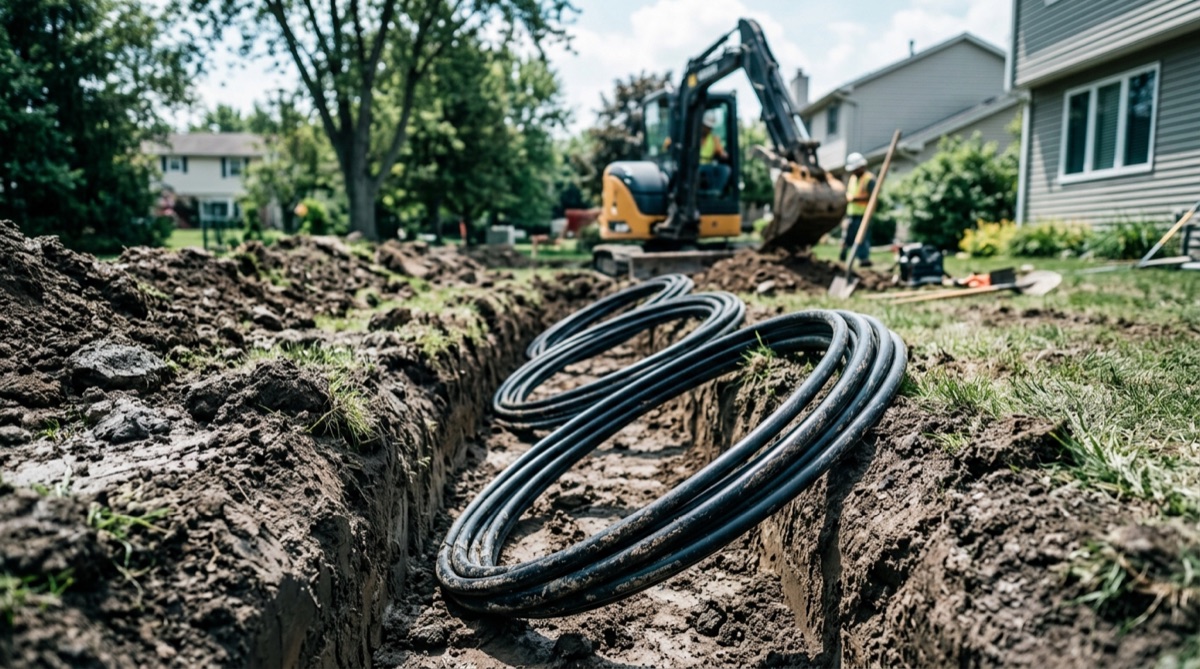
A horizontal ground loop going in. The loop field is the expensive half of most geothermal jobs — which is exactly why incentive programs matter.
ENDED
$25D residential credit
The homeowner credit that used to cover 30% of a residential install no longer applies to anything completed in 2026 or later.
0% for new 2026 home installs
ACTIVE
$48 commercial credit
Geothermal kept its commercial investment tax credit while wind and solar were phased down. It belongs to whoever owns the system — a business, or a leasing company.
6–50% base rate to fully bonused
VARIES
State & utility programs
Now the main event for homeowners. Generous in a handful of states, thin or nonexistent in most others — your utility territory sets the number.
Up to ~$40,000 stacked, in the strongest states
The federal picture: one door closed, several stayed open
The One Big Beautiful Bill Act (Public Law 119-21, signed July 4, 2025) rewrote the federal rules for geothermal. Here is the honest version of what it did — including two programs that no longer exist, because plenty of contractor websites still advertise them.
The homeowner credit is finished
Through the end of 2025, a homeowner could claim 30% of a geothermal installation’s cost under Section 25D of the tax code. The new law shut that down for any spending after December 31, 2025 — and the IRS reads “spending” as the day the system is installed and commissioned, not when you signed the contract or paid a deposit. A job contracted in November 2025 but finished in February 2026 gets nothing.
Two leftovers are still worth knowing:
- Carryforward survives. If a 2025-or-earlier install earned you more credit than you could use in one tax year, the unused balance still rolls forward on IRS Form 5695.
- Equipment bought in 2025, installed in 2026 sits in a grey area — whether it counts as 2025 spending is a question for a tax professional, not a salesperson.
The commercial credit was deliberately spared
Section 48 (and its successor, §48E) still rewards geothermal heat pump systems owned by businesses and other entities. Congress wound wind and solar down under the same law; geothermal was left standing. The schedule:
2026–2032: 6% base
30% with wage & apprenticeship rules met
Up to 50% with domestic-content + energy-community bonuses
2033: 5.2%
2034: 4.4%
After 2034: 0%
Churches, offices, multifamily buildings, farms, and other commercial projects can still build a real business case around this credit — which is why so much of the industry’s energy has shifted commercial.
Leasing: the back door back to 30%
Because §48 belongs to the system’s owner, a new arrangement has taken off in 2026: a leasing company installs and owns the geothermal system on your property, claims the commercial credit itself, and passes much of that value to you as a lower monthly payment. You get geothermal without buying it.
Read the fine print before signing:
- The equipment isn’t yours, so it won’t add appraised value to your home.
- Nothing lands on your tax return — no Form 5695, no credit to claim.
- Selling the house means assigning the lease; most contracts allow it, but check.
- Maintenance usually stays with the leasing company — a genuine plus.
For households that never had enough tax liability to use a credit anyway, a competitive lease can match or beat the old 30% deal. An uncompetitive one can’t — compare offers.
Two rebate programs people keep mixing up
HEAR (the High-Efficiency Electric Home Rebate program, §50122 — renamed HEEHR by a May 2026 DOE notice) is a point-of-sale rebate of up to $8,000 toward a heat pump, scaled by income: full value under 80% of area median income, half from 80–150%. One major 2026 catch: it now only covers swapping electric equipment for better electric equipment (or new construction). Replacing an oil, propane, or gas furnace no longer counts.
HOMES (§50121) is different machinery: a whole-house rebate paid on how much energy a retrofit actually saves, open to all incomes with bigger awards for lower-income households. Both are run by state energy offices, so availability and paperwork differ wildly by state — and normally you can’t use both on the same project.
Borrow it through the mortgage instead
With the credit gone, the cheapest money for a geothermal install is increasingly a mortgage product. Fannie Mae’s HomeStyle Refresh (launched March 31, 2026, replacing HomeStyle Energy) lets buyers and refinancers finance energy upgrades — geothermal included — against up to 15% of the home’s post-improvement value. Freddie Mac’s GreenCHOICE Mortgage does similar work, with debt-to-income flexibility that credits expected utility savings.
You get these through a participating lender, not from Fannie or Freddie directly. On the geothermal portion of a loan, first-lien mortgage rates typically undercut home-equity borrowing by roughly 1–3 percentage points.
Two programs to stop believing in
FHA PowerSaver was a pilot that ended in 2015; its last Federal Register notice covered loan applications dated before May 4, 2015. Any 2026 pitch that names it is reading from a very old brochure.
USDA REAP never covered ordinary homes — it serves farms and rural small businesses only. And as of an April 2026 rescission notice, its grants are paused; only REAP loans remain available. If someone offers you “REAP funding,” ask which half they mean.
Where the states step up — and where they don’t
Three states now carry geothermal economics almost single-handedly. In the best territories, state and utility help can erase a quarter to three-quarters of an installed price. Everywhere else, expect a modest utility rebate and a financing decision.
New York
$10,000
State tax credit — 25% of cost
New York doubled its residential geothermal credit from $5,000 to $10,000 on July 1, 2025. It covers 25% of what you pay for a system at your primary residence, unused amounts carry forward up to five years, and from 2026 lower-income households can elect to have leftover credit refunded instead.
Underneath it sits the NYS Clean Heat rebate, run through your electric utility — and how it’s calculated depends on where you live. Con Edison pays flat per-project amounts for a full-load retrofit: $25,000 at the standard rate, $30,000 for a weatherized home, up to $40,000 in disadvantaged communities, capped at 70% of project cost (85% in those communities). Utilities that pay by capacity instead — Orange & Rockland and National Grid, at roughly $2,000–$2,500 per 10,000 BTU/h of heating capacity — put a typical 3-ton system closer to $7,000–$9,000. Stack the credit on top and a $35,000 job in Con Edison territory can land under $10,000 out of pocket. A state property-tax provision (RPTL §487-a) also shields the added home value from taxation.
Massachusetts
$13,500
Mass Save whole-home rebate
Mass Save’s ground-source rebate for 2026 is $13,500 — trimmed from $15,000 the year before. Households at 61–80% of state median income can qualify for up to $25,000; those at or below 60% are routed to a no-cost income-eligible program instead.
Pair it with the HEAT Loan: 0% APR financing on the balance, with terms tiered by income (up to 7 years for lower-income households). The rebate and the loan are separate products that stack — older material quoting a “$15,000 HEAT Loan” is confusing the two.
Connecticut
1.99%
Smart-E loan special, through Dec 2026
Connecticut’s help comes as cheap money plus a per-ton rebate. Eversource and United Illuminating pay $1,500 per rated ton, up to $15,000 per home, for an ENERGY STAR ground-source system installed by a Heat Pump Installer Network contractor replacing fossil-fuel or electric-resistance heat.
The Smart-E Heat Pump Special then finances up to $25,000 over five years at 1.99% APR (the standard Smart-E rate is near 7–8%) for jobs booked between August 1 and December 31, 2026. Connecticut also exempts a geothermal system’s added value from property tax.
Claims circulating online that don’t hold up
-
Illinois has no state geothermal tax credit.
The “25% Illinois credit” in older articles has no statute behind it. The real money is utility-level: ComEd discounts up to $6,000 per home for a ground-source system including the loop (pre-approval and a certified installer required), and Ameren Illinois pays $1,350–$5,400 by system size, plus $500 if you add a desuperheater. ComEd’s smaller advertised discounts — up to $1,400 ducted and $1,000 ductless — are for air-source heat pumps, not geothermal; the two get quoted interchangeably online. A separate state geothermal credit program exists under the 2025 Clean and Reliable Grid Affordability Act, but its first credits aren’t delivered until 2028. -
Vermont has no state credit either.
What exists is a combined utility offer of up to $2,100 per ton — $1,800/ton from Green Mountain Power plus $300/ton from Efficiency Vermont — with a $500 bonus for income-eligible households. GMP’s often-quoted $2,000-per-unit deal is for air-source units, not geothermal. -
Indiana repealed its break.
The state’s geothermal property-tax deduction was wiped out retroactive to January 1, 2025. New installs get nothing — and vertical-loop drilling there requires a state-licensed driller, a compliance cost rather than an incentive. -
No sales-tax exemption in Virginia or Washington.
Washington’s renewable-energy exemption covers equipment that generates electricity, not heat pumps; Virginia has no statute exempting residential geothermal gear. Maryland, meanwhile, has no statewide property-tax exemption — only an optional credit that each county or town decides for itself. -
Pennsylvania & New Jersey PACE won’t help a homeowner.
Both states’ PACE programs are commercial-only. Homeowner incentives there run through utilities — PPL Electric, for one, pays a flat $500 for an ENERGY STAR ground-source heat pump under the state’s Act 129 efficiency program — though Pennsylvania owners can separately earn Tier II Alternative Energy Credits each year.
State-by-state at a glance
The states with documented 2026 geothermal programs, plus the states most often mis-described online. Every state not listed here has no state-level geothermal tax credit — homeowners there rely on whatever their local utility offers, which you can look up in DSIRE. “None” in the credit column means no state credit; a utility rebate may still apply.
| STATE | STATE TAX CREDIT | UTILITY / REBATE PROGRAMS | WORTH KNOWING |
|---|---|---|---|
| New York | 25% of cost, up to $10,000 |
NYS Clean Heat: $25,000–$30,000 flat per project in Con Edison territory (up to $40,000 in disadvantaged communities); ~$7,000–$9,000 typical with some other utilities | Added home value shielded from property tax under RPTL §487-a |
| Massachusetts | None | Mass Save: $13,500 (up to $25,000 moderate-income; no-cost program at lowest incomes) | HEAT Loan at 0% APR stacks with the rebate |
| Connecticut | None | $1,500 per ton, up to $15,000 (Eversource / United Illuminating) | Smart-E special at 1.99% APR through Dec 31, 2026; property-tax exemption for geothermal |
| Illinois | None | ComEd up to $6,000 per home; Ameren $1,350–$5,400 + $500 with desuperheater | State geothermal credit program starts delivering in 2028 |
| Vermont | None | Up to $2,100 per ton combined (utility + Efficiency Vermont); +$500 income-eligible | No state property-tax break specific to geothermal |
| Minnesota | None | Xcel Energy / CenterPoint utility rebates — confirm current amounts | Utility territory decides everything |
| Pennsylvania | None | PPL Electric pays a flat $500 for a ground-source heat pump under the state’s Act 129 program; PECO, Duquesne, and FirstEnergy run limited programs | C-PACE is commercial-only; homeowners can earn Tier II energy credits annually |
| Oregon | None | State Heat Pump Purchase Program: up to $2,000 per dwelling, ground-source eligible | Energy Trust of Oregon rebates cover air-source only |
| California | None | Utility and state energy programs, typically $2,000–$5,000 | Residential PACE financing available; the old HERO program ended in 2020 |
| Maryland | None | Limited utility programs | Optional local property-tax credit — depends entirely on your county or town |
| Indiana | None | Limited utility programs | Former property-tax deduction repealed Jan 1, 2025; licensed driller required for vertical loops |
| Virginia | None | Dominion Energy programs — confirm current amounts | No sales-tax exemption for residential geothermal |
| Washington | None | Utility programs vary by territory | State sales-tax exemption covers electricity-generating equipment only, not heat pumps |
Check the number before you sign anything.
Rebate amounts move — sometimes mid-year, and funding pools can run dry before December. Confirm the current figure with your utility and state energy office, or look it up in DSIRE, the national incentive database maintained by the N.C. Clean Energy Technology Center. Installer brochures commonly lag program changes by six months or more.
Rebate amounts move — sometimes mid-year, and funding pools can run dry before December. Confirm the current figure with your utility and state energy office, or look it up in DSIRE, the national incentive database maintained by the N.C. Clean Energy Technology Center. Installer brochures commonly lag program changes by six months or more.
What would you actually pay?
Slide the installed price, set your system size, and pick a scenario to see an estimated out-of-pocket cost using published 2026 program figures. It’s a planning estimate, not a quote — your utility’s current schedule is the final word.
Installed price
$30,000
$30,000
NYS Clean Heat rebate — Con Edison flat rate
(capped at 70% of cost)
-$21,000
NY state credit (25% of what you pay, max $10,000)
-$2,250
-$2,250
ESTIMATED OUT OF POCKET
$6,750
Con Edison pays flat per-project amounts: $25,000 standard,
$30,000 for a weatherized home, up to $40,000 in disadvantaged
communities. The Clean Heat rebate comes off first, then the
25% state credit applies to what you actually pay, up to $10,000.
Real costs, realistic payback
A typical 3-ton residential system runs about $25,500 installed nationally in 2026 — $20,000–$27,000 in easy digging, but $35,000–$50,000+ where granite and hard New England ground make drilling slow. For vertical loops, the hole in the ground is 50–70% of the bill, and prices have been climbing roughly 4% a year on specialized-labor costs.
Payback, honestly stated
- 7–12 years is typical where state and utility incentives apply.
- 10–15 years without meaningful incentives.
- 5–8 years in the best case: cold climate, replacing oil heat, full incentive stack.
What you’re replacing matters more than almost anything. Swapping out oil or electric-resistance heat saves the most (EPA figures run 30–70% on heating costs); displacing a modern high-efficiency gas furnace saves the least.
The long game favors geothermal
The indoor unit typically lasts 20–25 years and the buried loop 50 years or more — the loop outlives the house’s next two heating systems. Installs also tend to add resale value (studies put it around $8,700–$15,000 for a typical home), and long-horizon returns model out around 6–8%, reaching 10–12% for cold-climate oil replacements. Incentives decide the first decade; durability decides the rest.
Rebate money vs. credit money
A rebate cuts your price at installation, when cash is tightest. A tax credit pays you back the following April — on a $30,000 job with a $7,500 credit, you floated the government $7,500 for months. Rebates also hinge on your utility, not your state line: two homes twenty miles apart can face different offers, and high-efficiency equipment often unlocks a richer tier worth $1,500–$3,000 extra. Ask for the current rebate schedule — and the tier thresholds — before choosing equipment.
Financing is now a first-order decision
With no federal credit shrinking the balance, loan terms can swing total lifetime cost by a quarter or more. Compare at least two paths: a green mortgage product (HomeStyle Refresh or GreenCHOICE) at first-lien rates; a state loan like Mass Save’s 0% HEAT Loan or Connecticut’s 1.99% Smart-E special; or PACE financing, which repays through your property tax bill over ~20 years at typically 7–9% and attaches a senior lien that can complicate a future sale or refinance. PACE is convenient, never cheap.
Six traps that cost buyers money in 2026
Believing the 30% credit still exists
Old articles, brochures, and even some installer sites still promise it “through 2032.” For a home install finished in 2026, it’s zero. Check the IRS §25D page yourself.
Confusing HEAR with HOMES
One is an up-to-$8,000 point-of-sale rebate, now limited to electric-for-electric swaps; the other pays on whole-house energy savings. They’re different programs with different applications.
Trusting last year’s numbers
New York’s credit doubled and Massachusetts’ rebate shrank within the last year alone. Installers’ figures can be 6–12 months stale — verify with the agency.
Missing the funding window
Popular rebate pools can be exhausted before year-end. Apply at contract signing, not after the install.
Buying down to a price and losing a rebate tier
Minimum-efficiency equipment can forfeit thousands in tiered utility rebates. Ask which efficiency level unlocks the top tier before you spec the system.
Skimming a lease contract
Leasing terms run 15–25 years. Read the escalation clause, the home-sale assignment rules, performance guarantees, and end-of-term options as carefully as you would any two-decade financial product.
Questions homeowners are asking now
Can I still claim the federal geothermal tax credit?
The 30% residential federal credit under §25D no longer applies to a home geothermal installation completed in 2026 or later. If an eligible installation was completed in 2025 or earlier and you could not use the entire credit, the unused balance may still carry forward on IRS Form 5695.
Is there any route to a 30%-level benefit on a 2026 install?
Potentially, but not through the old homeowner credit. Commercially owned geothermal systems may still qualify for the §48/§48E commercial credit. That is one reason leasing arrangements have become more common.
Which states have the strongest packages in 2026?
New York, Massachusetts, and Connecticut currently stand out among the programs covered in this guide.
Can incentives be combined?
Sometimes. New York’s state credit can be combined with qualifying utility incentives, and Massachusetts’ HEAT Loan can be used alongside the Mass Save rebate. Always confirm stacking rules before signing a contract.
Can I finance a geothermal system inside my mortgage?
Yes. Certain mortgage products can finance qualifying energy improvements, including geothermal, when the borrower and project meet lender requirements.
How do I check whether an installer’s incentive claim is real?
Verify the amount directly with the utility, state energy office, or DSIRE rather than relying only on a contractor brochure. Programs and rebate amounts can change during the year.
Sources & further reading
-
Program figures compiled from 2026 state and utility documentation; background research:
GeothermalFinder — Geothermal Incentives by State (2026). -
DSIRE
— Database of State Incentives for Renewables & Efficiency (N.C. Clean Energy Technology Center). -
IRS — Residential Clean Energy Credit (§25D)
status and Form 5695 carryforward rules. -
Utility rebate schedules verified October 2026 against the utilities’ own program documents:
PPL Electric (Act 129),
ComEd Home Heating & Cooling,
and the Con Edison and Orange & Rockland Clean Heat pages. -
Mass Save
and
NYSERDA
for current rebate schedules in MA and NY.
Incentive programs change frequently and this page is a snapshot, not tax or legal advice.
Confirm eligibility and amounts with your utility, state energy office, and a tax professional
before committing to an installation.