

Home
About Us
Contact Us
Customer Reviews
Questions? We Can Help


HEAT SIPHON HISTORY - In 1983 when we made the first Heat Siphon, we predicted that
"Sooner or Later" ALL POOL HEATERS will use Heat Siphon's proven Swimming Pool Heat
Pump Technology. Today it is estimated that almost a fifth of all new pool heaters
sold in the US use Heat Siphon heat pump technology and growth is accelerating.
It's the right way to heat your pool.

Similar results that match your criteria

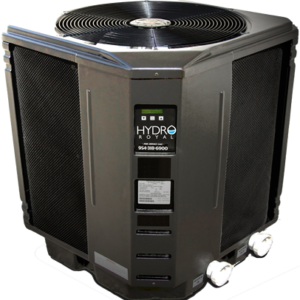
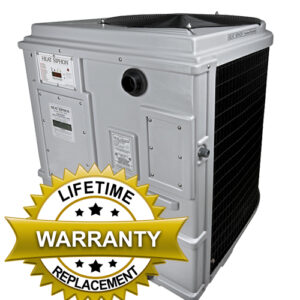
Hydro Royal pool heat pump
- Proudly built in the USA.
- Titanium heat exchanger to avoid corrosion, and coated components for salty-environment applications.
- Special cabinet material protects your unit from the weather, making it possible to install outdoors if necessary.
- Ultra-quiet operation at 56 dB. R-410A refrigerant.
- Digital display to accurately monitor water temperature.
- Best warranty in the market. Excellent customer service.
Jump right in
Pools aren't cheap, but in a few hours and for a fraction of your original investment, you can install a Heat Siphon and enjoy your heated pool anytime, rain or shine.
While your neighbor's unheated pool sits empty, you and your family swim in warm water for 3 to 5 months longer every year at the lowest cost possible. No children with blue lips, no excuses for skipping a pool party, just warm-water fun when you want it.
Think of the added family fun: the comfort of warm water from the youngest to the oldest, early morning laps or a late evening dip. Using proven, reliable and highly efficient heat pump technology, Heat Siphon saves you money every day without burning any costly fossil fuel. It's environment friendly too.
Six good reasons to own a Heat Siphon®
1. It saves 24/7 at 85°F ($3.00/day)
Heat Siphon is the most efficient and cost-effective type of pool or spa heater made. A 3.25HP model will maintain 85°F in a 15' x 30' pool in Portland, Maine or Miami, Florida for as low as $3.00 per day, based on US Department of Energy cost data.
We'll size a Heat Siphon for your pool and email you a free pool heating analysis with your own fuel costs. Request your free analysis.
2. It lasts for years
Heat Siphon keeps saving because it's corrosion proof. It has an electrically isolated titanium heat exchanger, a PVC cabinet and stainless steel hardware, built to last with proven, reliable heat pump technology.
3. It's worry free
Heat Siphon has the strongest warranty in the pool heating industry: a lifetime heat exchanger corrosion warranty with no chlorine limitations, and five full years of parts and labor on the compressor. It is not pro-rated like other heat pump manufacturers.
4. Set it and forget it
Use the simple two-button interface on the digital Heat Siphon, or turn the single knob on the proven analog model. It keeps your pool or spa within 1°F of the temperature you set, 24 hours a day. As long as your pool pump is filtering, Heat Siphon is keeping the water warm, so you can swim any time of day, rain or shine.
5. It runs quietly
Heat Siphon is quieter than your pool pump, with a low-noise fan, a sound-absorbing vacuum-formed plastic cabinet and rubber isolation bushings under the compressor. Scroll compressors in all models are even quieter because they use no pistons or valves.
6. It's environment friendly
Heat Siphon reduces CO₂ emissions by 36 to 46% by moving heat from the air, instead of burning fuel to make heat like fossil-fuel pool heaters do.

Spillover spa? It needs fast heat to bring the water from pool temperature (usually 78 to 86°F) up to spa temperature (usually 96 to 104°F).
What your pool guy might say about warranty and installation
Per Marcus Miller
"Your pool guy is not licensed or able to service your heat pump once it is installed. You need an HVAC refrigeration person for that.
So the same heat pump that I get you, or your pool guy gets, will be serviced by the same someone that the manufacturer sends out. As a product owner you will contact them to register your product and start a service call if there is an issue in the future. You will have a manufacturer's customer service number to help with troubleshooting and questions, or you can always call us at any time.
All the manufacturers know who I am. Most of the head engineers from all the companies know me too. I have a lot of cell phone numbers, some for 25 years. When I call a manufacturer they are very motivated to take care of my customer. They will not know who your pool guy is.
The installation for most heat pumps is to glue 2 water pipes and call a licensed electrician to finish the hook-up. It is not rocket science. Very easy.
And I'm always around to answer any questions. We want you to save money and we want you to be happy with a properly heated pool."
His advice has helped thousands of pool owners in different applications worldwide. Marcus Miller is a heat pump expert for geothermal, aquaculture and pool heat pump applications. Follow Marcus on LinkedIn.
Choosing and installing your Heat Siphon
Selecting your Heat Siphon model
1. Size: 200HP, 375HP, 575HP or 700HP
Choose one of four Heat Siphon sizes for the heat output you need, using the QuickSize chart below. Or let us do a custom sizing using your pool data with our free pool heating and sizing program: Free pool heating cost analysis.

Name plate data for all Heat Siphons (PDF)
2. Digital or analog
Pick your control system. Simple, dependable, no-frills single-knob 24-volt controls are used on all C-Series (analog) models. Z-Series (digital) models have a sophisticated feature set and an LED display showing status and water temperature, and are wireless ready. If you want to spend more up front, the Z-Series may be for you.
Pool and spa combo? You need the digital model for its dual thermostat and Auto-Pic features. The digital Player control is much more than a digital thermometer.

3. AC power supply
Virtually all residential pools use a 220-volt AC, 60 Hz (USA) dedicated circuit breaker to supply power to your Heat Siphon. Commercial pools, condominiums and export customers will probably need special model designations. Call us if in doubt.
4. Accessories
Several accessories are available for the digital Player, including the Easy-Pic pool/spa automation interface and the Easy-Clock plug-in, which adds a pump timer and PumpJump time clock override. Hardwired add-ons include the T-POD pump control and the T-POD Plus hardwired pool/spa control.
Pick your model
First decide whether you will use a pool cover. A cover can save about 50% of your heat loss and let you use the next smaller Heat Siphon, so consider a cover. These guidelines are for normal conditions: low wind, no shade, 80°F pool water, 24-hour pool pump operation and an average air temperature above 55°F for the swim season.
- C200HP or Z200HP: from 200 sq ft (20 m²) with no cover to 275 sq ft (25 m²) covered.
- C375HP or Z375HP: from 350 sq ft (30 m²) with no cover to 650 sq ft (50 m²) covered.
- C575HP or Z575HP: from 650 sq ft (60 m²) with no cover to 800 sq ft (75 m²) covered.
- Z700HP: from 800 sq ft (75 m²) with no cover to 1,000 sq ft (93 m²) covered.
If these don't fit your pool, get a custom sizing report.
Classic or high tech? After you have the right size, the rest is up to you. If you're on a budget and want the most economical model, pick the classic C-Series analog model, made in Latrobe, PA since 1983. It's a no-frills, single-knob, set-it-and-forget-it pool heater: simple, reliable and old-fashioned, but high quality.
Remember: no matter which model you select, once it's installed the only things you'll notice are the warm water and the low electric bill.
Heat Siphon history: the first Heat Siphon was a 3.25HP model with a piston compressor and the classic analog 24-volt control system, built in August 1982. The analog Heat Siphon still lives on.
Installing your Heat Siphon: locate, plumb, wire
Heat Siphon® can be installed by any factory-authorized pool dealer or pool service contractor. Depending on local building code requirements, the installing dealer may also run the electrical wiring or subcontract a licensed electrician.
Location
Heat Siphon needs fresh air, so it must be outdoors in the open. No pump rooms or sheds (for indoor installations, call the factory). It should be downstream of the pump and filter and upstream of any chlorinators.
Plumbing
Plumb it into your pool or spa filter circulating system like a length of PVC pipe. No copper heat sink pipes are required. Plumb standard 1.5" or 2" schedule 40 PVC pipe directly into the heat exchanger (2" requires a female adapter fitting).
Wiring
220-volt AC power from a dedicated circuit breaker is the only "fuel" required.
Do not install with in-floor cleaning systems in the same pump loop.
Caution: this equipment requires 220-volt power from a dedicated circuit breaker. All electrical wiring should be performed only by a qualified electrician according to all local building codes.
What you need
- Minimum 25 GPM pool pump water flow (80 GPM max)
- Dedicated 220-volt AC circuit breaker (all domestic Heat Siphon models)
- Lots of fresh outdoor air
What's not required
- No pilot light to blow out and relight
- No flames or hot combustion gas vent stacks
- No danger of explosion
- No gas, propane or oil piping lines to run or bury
- No gas, propane or oil tanks above or below ground
- No copper heat sinks to prevent PVC pipe from melting
- No wind breaks to shelter a burner flame
- No unsightly solar collectors
Attention, do-it-yourselfers: call the factory to see if you are qualified to self-install. Many trade professionals with plumbing or construction experience have the background.
Fresh air
As the "How It Works" animation shows, Heat Siphon gets over 80% of its heat from cooling the outside air that its fan pulls through the evaporator. It cools about 5,000 cubic feet of air by 3°F to 5°F every minute. That's why you can't locate it indoors (except where additional requirements are met, see indoor pools), and never where the exhaust air can recirculate back into the evaporator.
25 GPM water flow
Most 1HP and larger pool pumps with normal pool plumbing will easily exceed 25 gallons per minute. Typically they deliver 40 to 60 GPM, and a 2HP pump can put out 80 GPM with 2-inch pipe. If in doubt, ask your pool dealer or check the manufacturer's specifications for your pump.
Dedicated breaker
Every Heat Siphon requires its own circuit breaker, not a shared one. The maximum size is listed on your nameplate.
Location: fresh air, water and wire, but no fire
Heat Siphon performs well in any outdoor location with three things present: fresh outdoor air, 220-volt AC electricity, and pool filtration piping. To avoid the expense of extra piping, fittings and heavier-gauge wire, locate it as close as possible to your pool pump filter and outdoor power center.
Outdoors with fresh air
Heat Siphon may be installed virtually anywhere outdoors. Unlike a gas heater, it has no draft or pilot light problem in a windy area. Direct sunlight is not a concern, since the cabinet is made of UV-stabilized, flame-retardant plastic.
Do not place Heat Siphon in an enclosed area with limited air volume, where its discharge air will be recirculated, or close to shrubs that can block the air inlet. These locations rob it of fresh air by letting the colder exhaust air mix with the air entering the evaporator. That cools the air even further, reduces efficiency and makes the compressor work harder.
If the space is confining enough, the air will drop so low that the unit will ice up, shut off and short cycle. Installations like these will void your warranty. Prevent recirculation of the exhaust air, because it cuts efficiency.
Do not locate your Heat Siphon in these places
- Under a deck
- In a pump house
- In a garage or basement
- Indoors
- Under an eave or overhang

How close to your pool?
Normally, the pool pump and Heat Siphon are installed close together and within 25 feet of the pool. The longer the distance from the pool, the more heat is lost from the piping. Since the piping is usually buried, heat loss is minimal for runs of up to 50 feet (100 feet total there and back) unless the ground is wet or the water table is high. A rough estimate is 2,500 BTU/hr per 100 feet for every 10°F difference between the pool water and the surrounding ground, which means about a 3% to 5% increase in run time.
Allow plenty of space
Leave plenty of space around the unit to prevent cold exhaust air from recirculating into the inlet, and for future service access.
- Allow 24 to 36 inches of open area all around the Heat Siphon for good air circulation.
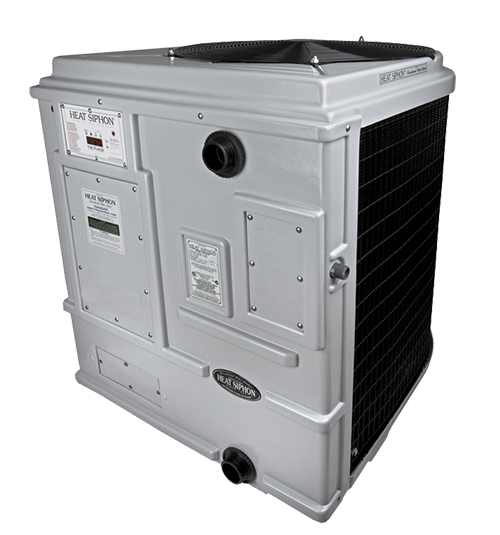
- Allow 36" minimum for service access, along the flat front face where the two doors are located.
- Keep the unit level so condensation and rainwater drain. A standard 1/2" barb fitting is on the lower right side of the base pan, and standard flexible tubing slips over it to direct condensation away.
- To minimize noise, position the flat side of the unit toward your sitting area. This side has the lowest noise emissions.

Dimensions and technical specs
All models have the same footprint (see top view). All 375HP and 575HP models are 39" high, and all 200HP models are 31" high. The power connection junction box is on the right side of the flat front panel, and the grounding lug and condensation drain are both near the lower right corner.

| Models | Boxed dimensions (W x D x H) | Raw unit dimensions, including conduit clearance (W x D x H) |
|---|---|---|
| All 375HP and 575HP | 34" x 39" x 46" | 32.5" x 37" x 39" |
| All 200HP | 34" x 39" x 36" | 32.5" x 37" x 31" |
Wiring: dedicated circuit breaker
Install a circuit breaker in your pool equipment panel and run wire.

Heat Siphon has a separate molded-in junction box with a standard electrical conduit nipple already in place. Remove four screws and the small cover, feed your supply lines in through the nipple, and wire-nut the supply wires to the three pigtails already in the junction box (four wires if three phase).
To complete the hookup, connect the unit by electrical conduit, UF cable or other suitable means, using the proper size wire as permitted by local electrical codes, to a dedicated AC branch circuit with the proper circuit breaker, disconnect or time-delay fuse protection.
Electrical bonding
Bonding is required to a local earth ground (separate from the power supply grounding) through a solid copper conductor not smaller than #8. This bonding wire should also be connected to any other pool or spa system electrical equipment. Heat Siphon has a standard copper bonding lug on the right side of the unit, facing the front panel.
Disconnect required
For safety, a disconnect (fused or un-fused switch, or circuit breaker) should be within sight of and readily accessible from your Heat Siphon. This is common practice on commercial and residential air conditioners and heat pumps. It prevents remotely energizing unattended equipment and lets you cut power while the unit is serviced.
Note: the heat exchanger is electrically isolated from the rest of the unit, which only prevents the flow of electricity to or from the pool water. Grounding the unit is still required to protect against short circuits inside the unit. Bonding is also required.

What size wire?
Your electrician should determine the wire gauge from the nameplate's minimum circuit ampacity, the smallest current your supply wire must safely carry. The size depends on that amperage and the length of the wire run. All wiring should follow the National Electrical Code and all local building codes.
Breaker size
The supply circuit breaker or fuse should match the size on the nameplate of the model being installed. Where possible, a good-quality ground fault interrupter (GFI) breaker is strongly recommended at the main power supply for all single-phase electrical equipment in the pool system.
Plumbing: glue directly to 1.5" or 2" schedule 40 PVC
Do not use a bypass. Heat Siphon requires full flow, up to 80 GPM. Locate it in the pool pump discharge (return) line:
- Downstream of your pool or spa pump and filter, no matter what type
- Upstream of pool or spa chlorinators, ozone generators or chemical pumps
- Not in the same plumbing loop as any in-floor cleaning system

Heat Siphon's full-flow titanium heat exchanger needs no special plumbing or bypass. The water pressure drop is less than 1.5 psi at 80 GPM. Because there is no residual heat or flame temperature, no copper heat sink piping is needed, and PVC pipe can run straight into the unit.
The heat exchanger is all PVC and connects to either 1.5" or 2" schedule 40 PVC filtration piping. Both the inlet and outlet have a 1.5" inside diameter for slip (glue) fitting to 1.5" pipe, and 2" male pipe threads on the outside diameter for 2" schedule 40 pipe using a female adapter sleeve or coupler. Both keep the pipe opening clear all the way into the heat exchanger, so there is no pressure drop.
Consider adding quick-coupler fittings at the unit inlet and outlet to allow easy draining for winterizing and easier access for service.
Not compatible with in-floor cleaning systems. Do not install any Heat Siphon in the same pump or plumbing loop as an in-floor cleaning system. Doing so will void your warranty. Water hammer damage has been known to occur in the same loop, especially with a larger pump and 2" or larger piping. Use a separate pump and plumbing loop for in-floor cleaning systems, independent of the heating piping.
Multiple unit installation
The only difference between installing one Heat Siphon and several on one pool is the plumbing. Each unit still needs its own dedicated circuit breaker, and all the rules about location, bonding and wiring apply to every unit.

There are four rules for plumbing multiple Heat Siphons:
- Make sure each unit gets at least 30 and up to 80 GPM of water flow.
- Plumb them in parallel. Never connect the outlet of one Heat Siphon to the inlet of another.
- Make each circuit the same length of water travel, which naturally helps balance the flow to each unit.
- Where possible, put shutoff valves and a flow meter at each unit so you can service one without shutting down the system, and confirm and balance the flow rate.
This is simple for two units but gets more complex as the number grows. Just balance each circuit: the distance the water travels should be the same for every unit, from the branch-off header back to the collection header.
For example, one of the larger multiple-unit installations, over ten years old, is a community pool in Cranberry Township, PA with twelve Heat Siphons. The supply and return headers are 6" schedule 40 PVC, branching to three 4" feeders that each supply a bank of four units. Each unit's inlet and outlet uses 1.5" PVC. The return trip is the same in reverse.
Please call us if you need help with multiple-unit plumbing: 1 888 205 7766.
Heat Siphon warranty information

Here is our warranty, no questions asked
All parts in the Heat Siphon are warranted for two (2) years, material and labor, except as noted in the full warranty.
More helpful hints
No bypass or check valves
Plumb Heat Siphon like a piece of PVC pipe. No bypass is required.
Location
Connect Heat Siphon in the pool pump discharge (return) line, downstream of all filters and pool pumps and upstream of any chlorinators, ozone generators or chemical pumps.
Condensation
Heat Siphon cools the air by about 4 to 10°F, so water may condense on the fins of the horseshoe-shaped evaporator. If the humidity is very high, this can be several gallons an hour. The water runs down the fins into the base pan and drains through the barbed plastic fitting on the right side of the base pan. The fitting accepts 3/4" clear vinyl tubing, which pushes on by hand and can run to a suitable drain. Many people mistake condensation for a leak inside the unit.
Tip: a quick way to check that water from the base pan is condensation and not a plumbing leak is to test it for chlorine. If there is no chlorine, it's condensation.
Heat Siphon technical support
This section is devoted exclusively to technical support. Click the image for the product you need help with.



Need help sizing your pool heat pump?
Use our Pool Heat Pump Heat Analysis form and we will prepare a heat load report for your location, weather and needs.
Call us now: 1 888 205 7766